Campana Issue #4: The rules are catching up... and so is student confidence.
THE PREP PERIODQuick tips, tools & tricks you can take to the classroom on Monday Create an automated “of the day” suggestion | This week's tip comes from Aldeya Keep a fresh daily touchpoint in your classroom without increasing your daily workload. Instead of spending your prep period coming up with a new question on your own every day, prompt AI to generate a ready-to-use suggestion. Once you're happy with the output, you can set yourself up with suggestions and starting points for the whole unit - or school year - at once. Review the outputs and make edits where necessary. A few directions you could go:
Misconception of the Day - a common student error or myth, with an explanation of why it's wrong and how to address it
Sentence of the Day (mentor sentence) - a published sentence worth studying for craft, grammar, or style
Root of the Day - a Latin/Greek root, prefix, or suffix that unlocks a whole word family (especially strong for multilingual learners)
Question of the Day - a higher-order discussion prompt tied to content
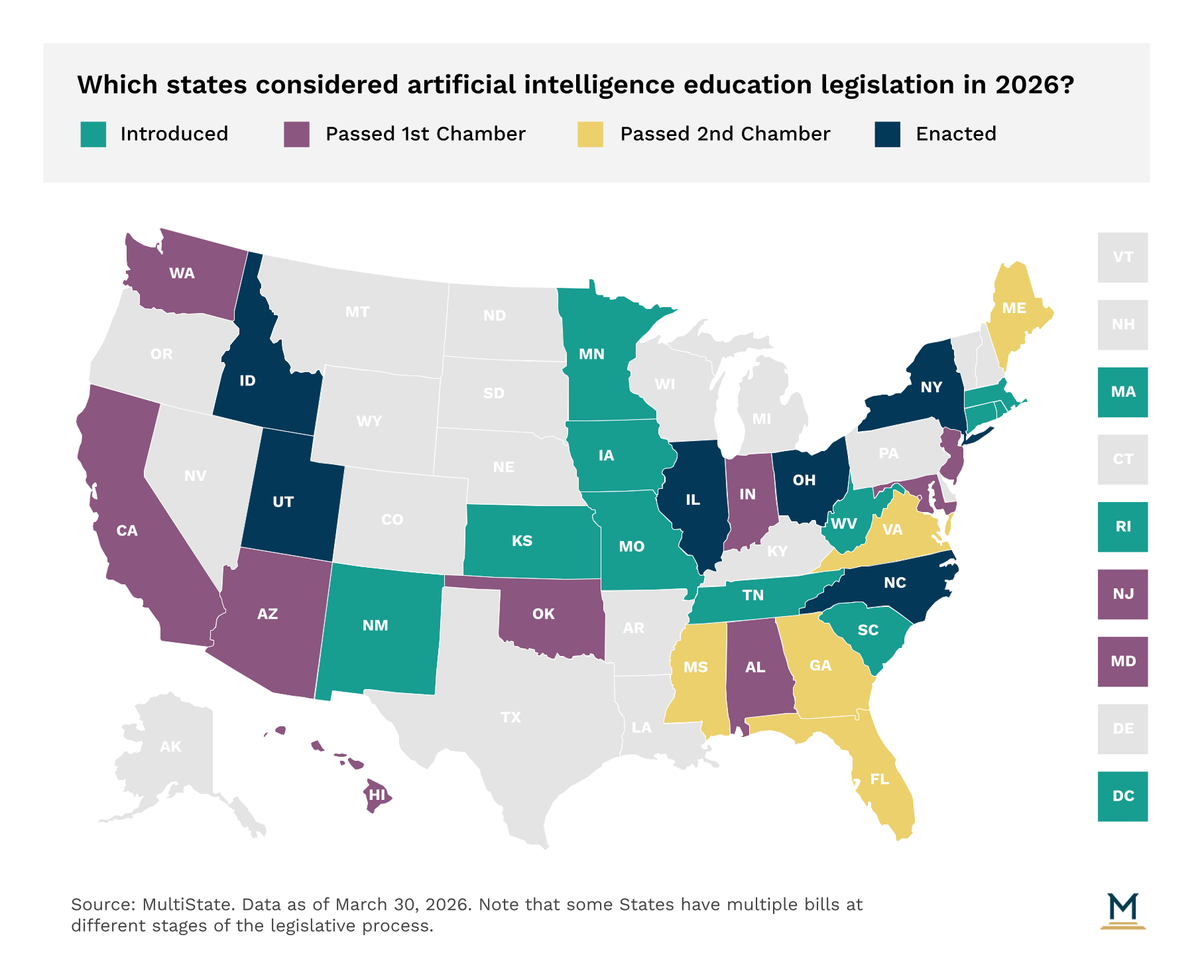
Sample Prompt Structure: Designate a misconception of the day relevant to [subject area] for [grade level(s)] students. Provide a common misconception, provide discussion questions to dive into the error, then explain why students commonly believe it, and provide a clear, accurate correction with an example or analogy students can remember. Follow-up prompt: Give me a misconception of the day for all [#] days of the school year, organized by unit or topic. LOUNGE READSThis week's articles highlight on-going AI tensions from three different angles: AI is already in classrooms, the policies aren't, and the debate about what AI should actually be doing for students and teachers is just getting started. State lawmakers are moving, districts are scrambling, and the edtech industry is busy reframing its pitch. Governing Schools Dive Into AI Without a Road Map Districts are rolling out AI tools while figuring out what the rules should be. “We gave students keys to the sports car before we gave them any drivers’ ed." Fast Company The Future of AI in Schools Isn't Personalized Learning A fresh argument for what AI in classrooms should actually be used for instead. "Personalized learning puts the algorithm in the driver’s seat. But personalized teaching puts the teacher there, with dramatically better data, better tools, and more time to do what only a teacher can do." Multistate How States Are Regulating AI in Education This Legislative Session A useful roundup of what state lawmakers are actually doing on AI and schools right now.
SARAH'S PICKGallup / Walton Family Foundation / GSV Ventures High student usage of AI doesn't always equal excitement, but offering structured guidance and candid conversation can transform a sense of dread into a sense of confidence. I've been observing how young people are talking about AI, and I'm not hearing a lot of excitement. There's a tension that's been difficult for me to put my finger on - a sense of dread with a side of resignation. New research from Gallup shows that in the past year alone, Gen Z's excitement about AI fell 14 percentage points, to just 22%. Hopefulness sits at 18%. Gallup senior education researcher Zach Hrynowski offered one explanation for what older students may be thinking. "AI is taking my job. I just went to college for four years: I spent all this money and now it's turning my industry upside down." The tension here is that students are still using it regularly anyway. More than half of Gen Z uses AI at least weekly, but anxiety remains constant regardless of how often they use it. And when the adults in their classrooms are themselves uncertain or resistant, students are left to navigate that tension completely alone. In a recent episode of P.S. Weekly, a student-run podcast out of New York City, a student from Williamsburg Charter High School described what it looks like at his school: some teachers want to flat-out ban AI, while others are trying to figure out how to use it collaboratively. But what we know about kids is, banning something doesn't make them less likely to use it. They're just more likely to use it without any scaffolding, framework, or honest conversation about what they are actually afraid of. The good news is, the Gallup data also shows that when schools create structured AI guidance, student confidence rises. The share of K-12 students who report that their school has AI rules jumped from 51% to 74% in just one year, and the share who believe they'll have the AI skills they need after high school rose 12 points right alongside it. Students want to be ready for a future that includes AI, even when they are nervous about it. Educators should prioritize structured, purposeful AI engagement that builds genuine competence and confidence, rather than assuming exposure alone is enough. If your students seem anxious or resistant about AI, that's an opening for learning. Underneath the resistance is usually a kid who already knows this technology is going to change their world, and isn't sure they'll be ready for it. A good place to start is just asking. What are they worried about? What do they wish they understood better? Start with a question and see where it takes you. A NOTE BEFORE YOU GO...I'm glad you're here! If something resonated this week, hit reply and tell me. If you know a fellow educator who would find this useful, forward it their way. The village grows when educators share with other educators. |
Campana
The weekly AI newsletter for educators, by an educator.
THE PREP PERIOD Quick tips, tools & tricks you can take to the classroom on Monday AI-Ready > AI-Proof | This week's tip comes from eSchool News There's a lot of energy right now around making classroom work "AI-proof." Filters, detectors, locked-down browsers. But as educators, we know AI is in our students' pockets (pocket calculator throwback). Designing around it may be less useful than designing with it in mind. That means shifting the question from "how do I prevent AI use?" to "what...
THE PREP PERIOD Quick tips, tools & tricks you can take to the classroom on Monday AI for Education Prompt Library | This week's tip comes from AI for Education Recently, I went exploring a bit in the AI for Education prompt library to see if anything new stood out to me. It occurred to me that I had never reviewed their professional development section. Which is wild because I spent a lot of my former teaching life obsessing over what makes good PD. While perusing, I found one that stood out...
THE PREP PERIOD Quick tips, tools & tricks you can take to the classroom on Monday How to Google in the Age of AI | This week's tip comes from K-12 Dive "I'll just Google it!" Google has really gained our trust over the past couple of decades. However, I'd argue Google AI Overviews have not yet earned that trust. Students are seeing Google AI Overviews when conducting searches in Google whether they intend to use AI or not. AI summaries now land at the top of almost every search, and one...